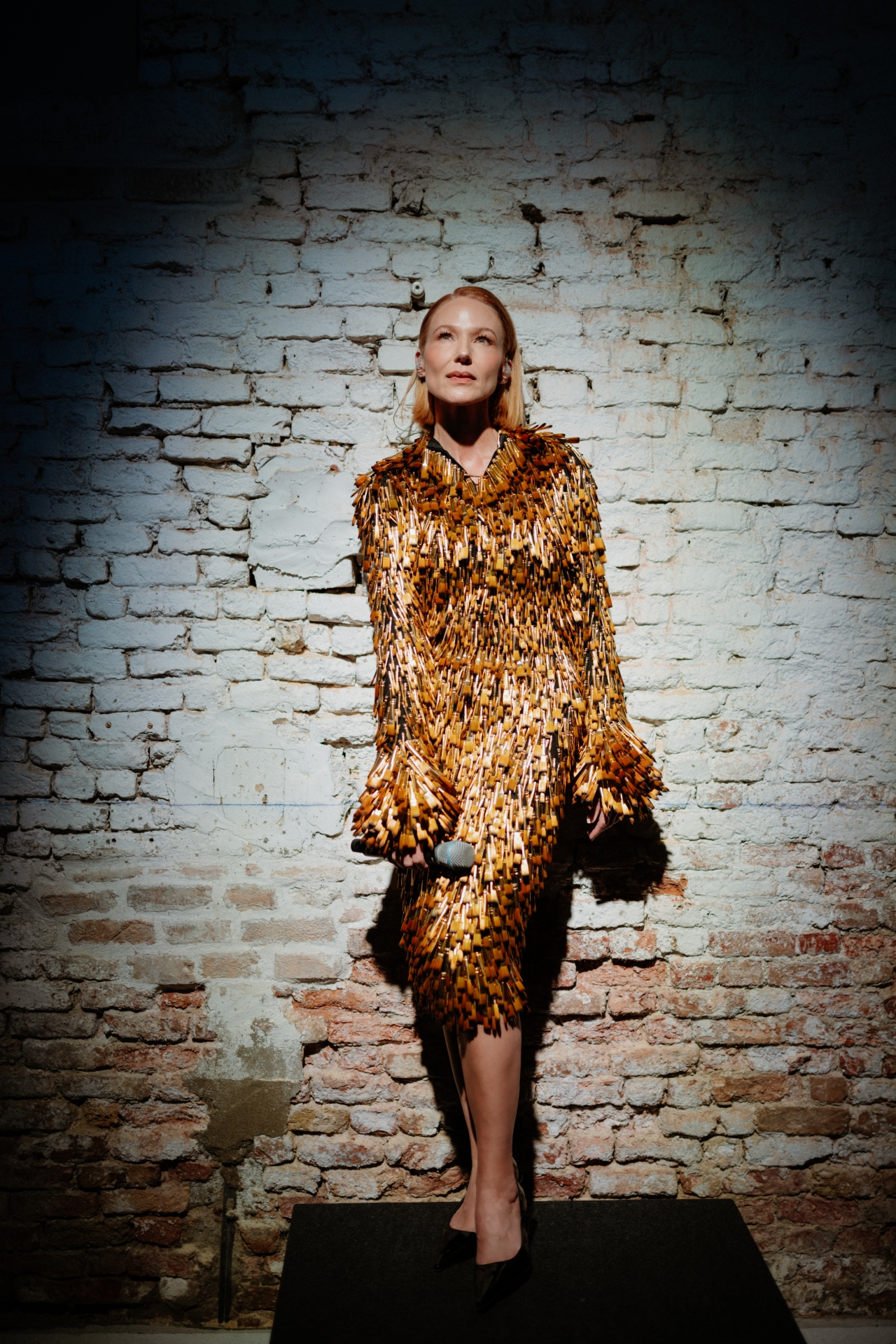
Nearly 200 art world luminaries gathered to celebrate the opening of Jewel’s Matriclysm: An Archaeology of Connections Lost. The evening included an exhibition preview, intimate walk-throughs of the exhibition with the artist, the curator Joe Thompson, Curator-at-Large for Crystal Bridges, and Rod Bigelow, Executive Director and Chief Diversity & Inclusion Officer at Crystal Bridges, which presented the show. Jewel wore the famed Schiaparelli paintbrush gown by Daniel Roseberry, a surrealist masterpiece covered in 6,000 hand-embroidered golden brass brushes that move like paint strokes, blending art and fashion. Special thanks to the designer for lending the dress. After the intimate exhibition tour, Jewel performed a live melody from the installation Seven Sisters, an immersive sound and light piece that transforms data from the Plaiedes constellation into a flickering light pattern that moves among seven hand-blown glass orb sculptures.
Guest highlights included Mariët Westermann, Director and CEO of the Solomon R. Guggenheim Museum and Foundation; Melissa Chiu, Director of the Hirshhorn Museum and Sculpture Garden and incoming Director and CEO of the Solomon R. Guggenheim Museum and Foundation; Alexandra Munroe, Senior Curator at Large, Global Arts at the Solomon R. Guggenheim Museum; Joan Weinstein, Director of The Getty Museum; Adam Levine, Director of the Toledo Museum of Art; Giulio Manieri Ella, Director of the Gallerie dell’Accademia; Suzanne Deal Booth, art collector and patron; Robert Rosenkranz, philanthropist and Chairman of Delphi Capital Management; Wendy Fisher, philanthropist, arts activist, and artist; and Katrin Henkel, collector, Trustee of the National Gallery, and Visiting Committee member at The Metropolitan Museum of Art.
Seven Sisters was created by Jewel in Toledo, Ohio, in residence at the Toledo Art Museum’s in-house glass studio. Jewel created an original, twelve-minute meditative soundscape to accompany the installation, converting data gathered from NASA and the University of California, Berkeley, from light wavelengths emanating from the constellation into sound. The soundtrack is designed to subtly alter the states of human brain waves, in a technique the artist has termed “neuro-ceutical.”
Accompanying the Seven Sisters are a body of new paintings created by Jewel in her signature realist, surrealism-tinged style, sparking reflection on motherhood and the divine feminine. Paintings include: a portrait of the artist and her son facing one another; a collection of small, gem-like, miniaturist paintings featuring surreal, sometimes discordant images (an egg, a clock, a raven, Henrietta Lacks, Albert Einstein’s wife Mileva Maric, a tarot card, a pill bottle, and more). On another wall hangs four larger paintings, a group of crone-like women, with trees of life sprouting horn-like from their heads, festooned with objects of pop culture and everyday life.
A second gallery focuses on humanity’s connection to nature and features Heart of the Ocean, an eight-foot sculpture that translates real-time oceanic data into a captivating visual and auditory display reflecting the ocean’s ever-changing state. Designed to embody the dynamic relationship between human activity and the sea, Jewel worked closely with leading scientists from NASA, NOAA, Stanford University, and UC Berkeley to record temperature variations, migratory animal patterns, wave activity, salinity, and other indices of oceanographic health. Using both live and historic data together with music algorithms written by Jewel, Heart of the Ocean creates and then “sings” a slowly evolving 12-minute soundscape, lending the sea its own resonant voice, and a surprising, almost creature-like, presence. Accompanying the sculpture is a tapestry of a woman consumed by flames, dressed in corporate garb, serving as a summation of the previous gallery, with many of the keystone symbols and relics gathered in an emergency to-go bag, and a fiery connection to the drama of Heart of the Ocean.
In another gallery, a digital series of four female figures drifts across the sky, hanging by various forms of birth control, referring, perhaps, to both the liberation birth control offers to women but also the disconnection from one’s body – and outright harm – it may cause. The viewer is left to decipher and create meaning from these images through their own experience and interpretation
A culminating piece that serves as a beginning and conclusion to the exhibition is a monumental sculptural work of a pregnant kneeling woman titled First Mother, made in collaboration with Cape Town-based Congolese artist Patrick Bongoy. The sculpture references the so-called mitochondrial mother, the single woman to whom the chromosomal threads of all humanity can be traced. It will be outside for the eight months of the exhibition, exposed to sun and rain, its organic elements left to grow, transform, and decay. Working in concert with Jewel, the artists have woven the First Mother’s skin from strands of hessian thread, embedding it with emblems of creation, renewal, and death, symbolizing the path of humanity, particularly mothers.
The exhibition is accompanied by a full-color catalog with an introduction by Susan Magsamen, co-author of Your Brain on Art: How the Arts Transform Us, as well as an exclusive interview between Jewel, artist Patrick Bongoy, and Nigerian curator Azu Nwagbogu, who played a key role in introducing Jewel to Bongoy and guided their collaboration, and is featured in the catalog.
Images courtesy fo Matthew Takes