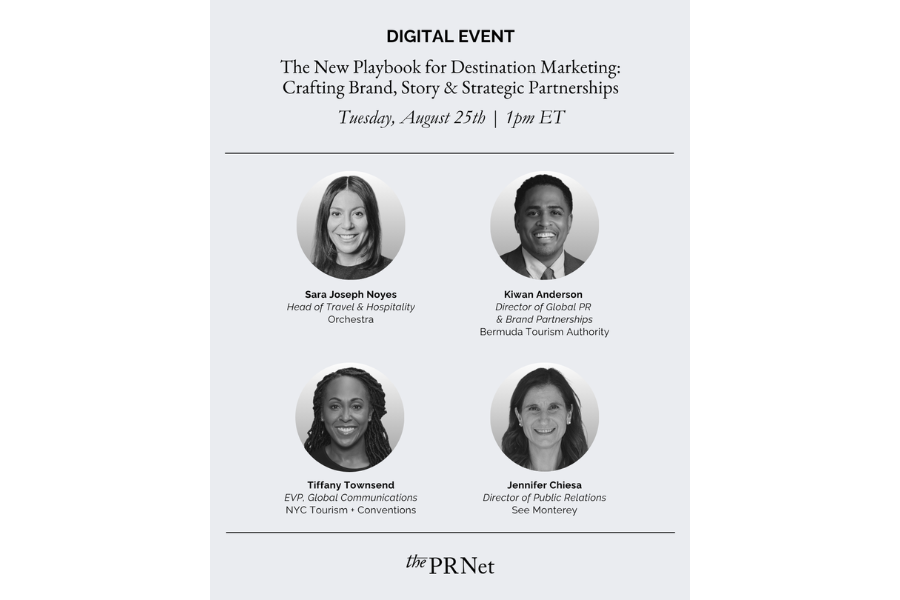
The PR Net Digital Event Recap: The New Playbook for Destination Marketing: Crafting Brand, Story & Strategic Partnerships
Destinations have become some of the most sophisticated brands in the world, building distinct identities, competing for attention across the same channels as consumer brands, and turning creator and partner relationships into real cultural relevance. In this webinar, we explored how today's leading destinations are defining their brand, telling their story, and building partnerships that last. We heard from Kiwan Anderson, Director of Global PR & Brand Partnerships at Bermuda Tourism Authority; Tiffany Townsend, EVP of Global Communications at NYC Tourism + Conventions; and Jennifer Chiesa, Director of Public Relations at See Monterey, in a discussion moderated by Sara Joseph Noyes, Head of Travel and Hospitality at Orchestra. They covered how destination identity has evolved alongside traveler expectations, how the creator landscape has reshaped their approach, and what makes a brand pitch or collaboration actually stand out.
The takeaways:
Destinations now operate as full-fledged consumer brands, with a core identity — the warmth of local people, the diversity of experience, a genuine sense of place — that stays consistent even as travel trends shift around it.
For widely recognized destinations, the challenge isn't awareness but definition; travelers arrive with an image formed by film, television, and music long before they ever consider booking.
Creator selection has moved well beyond reach and follower counts, with values alignment as the first filter — whether a creator supports local businesses, travels responsibly, and acts as a good steward of the place.
The best creator work takes a traveler one layer deeper — helping someone navigate a complex city, or making a destination feel possible for travelers who assumed it wasn't for them.
Long-term relationships consistently outperform one-offs, and the most valuable partnerships often emerge organically from creators who return again and again; small collaborations compound into repeat trips, consumer activations, and doors opened to other brands.
Major sporting and cultural events create real opportunity for neighboring destinations, especially when a campaign reaches an audience the destination couldn't access on its own.
Pop culture is among the most effective booking triggers, with television, film, and book-driven travel putting destinations back into cultural conversation and reaching entirely new communities of readers and viewers.
The clearest way to break through as a brand or agency is offering access — audiences, demographics, or media relationships the destination team can't reach alone — and conversion, not impressions, is the measure that matters.
Influencer trips are due for a rethink, with more meaningful itineraries over one-off photo opportunities, and traditional travel journalists still essential alongside creators — different experiences, measured differently.
There's growing pushback on the idea that visitors must "live like a local," with destinations reframing tourism itself as something positive and worth being proud of.
The industry is shifting from destination marketing to destination management, focused on responsible growth — steering visitors toward lesser-known areas and off-peak timing rather than simply driving volume.