As AI reshapes how brands create and communicate, the industry's most original voices are pushing back—not against the technology itself, but against its flattening effect on creativity. From handmade illustration to the irreplaceable instincts of lived experience, a new consensus is emerging: the more automated the landscape becomes, the more valuable the human fingerprint. Three leaders in marcomms weigh in on what AI can't replicate, and why originality may be the industry's most valuable currency yet.
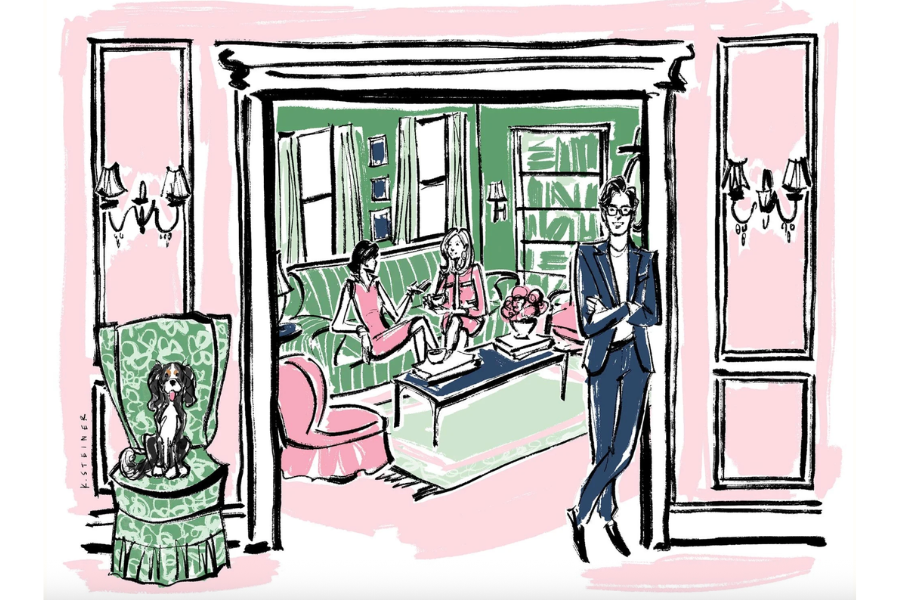
The Showhouse at The MART
The Return of the Handmade | MJ Fasan, CEO & Founder, Jo Communications
You might have noticed it on Instagram, in posts from brands like J.Crew and Merit, or in the promotion of The Showhouse at The MART or the post-Neocon coverage for showrooms like Scandinavian Spaces. Brands are embracing creative elements—illustration, handwritten typography, paper textures, collage, imperfect photography, and unexpected compositions—that unmistakably bear the fingerprints of the people who made them. Across the design world, there's a growing appetite for images that feel undeniably human, work that couldn't have been generated by a prompt.
The emerging trend comes at a time when we're all grappling with the future of creativity. Over the past few months, it seems nearly every conversation we've had with clients, colleagues, editors, and designers has eventually landed on AI. Not in a fearful way, but in a thoughtful one. The discussion has evolved beyond if we're using AI tools to how we're using them—and what guardrails we're putting in place to protect the creativity, judgment, and original thinking that define our work.
Like most businesses, we've found AI incredibly useful. It helps us organize, research, synthesize information, explore ideas, and move more efficiently through our day. (We even ran a draft of this newsletter through it to flag any errors.) But AI's rapid adoption has also produced an unexpected effect: the more polished, optimized, and algorithmically generated the internet becomes, the more we're collectively drawn to evidence of the people behind the work.
We're not the only ones noticing. Publications from Fast Company to The New Yorker have all explored the growing fatigue against generic AI aesthetics and the renewed value consumers place on originality, craft, and visible human authorship. At a time when so much visual content feels polished to the point of predictability, moments of authentic craftsmanship feel refreshing, distinctive, and ultimately, more memorable.
Perhaps that's AI's greatest irony. Rather than diminishing the value of creativity, it's amplifying it. Technology will continue to evolve, but originality, taste, judgment, and perspective remain uniquely human qualities, and knowing what resonates emotionally, what tells a compelling story, and what creates genuine connection can't be automated.
That's still the work of designers, writers, artists, photographers, and storytellers. For those of us working in creative industries, that's an exciting place to be. The future won't belong to those who resist AI or rely on it entirely—it will belong to those who know how to use it without becoming indistinguishable from it.
Culture Cannot Be Prompted | Cheryl Overton, Founder & CXO, Cheryl Overton Communications
AI raises the premium on humanity. The more artificial intelligence advances, the more valuable human originality becomes. AI can summarize research, generate concepts and accelerate execution, but it can’t smell the spices in a neighborhood market, strike up a conversation with a 10-year-old or understand why a 13-course meal in Copenhagen changes the way you think about craftsmanship. Lived experience is the creative advantage. While AI can process information, it’s people who collect meaning. Culture is sensorial; you can’t prompt your way into it. That’s why I believe the future belongs to brands that use AI for efficiency but invest disproportionately in human originality.
Focus on the who before the what: One of my earliest earned media successes came from helping launch the Reject Film Festival, built on a beautifully human idea that creators deserved more than a form rejection. They deserved to understand why. Looking back, I now realize that’s the origin story for EDGEWISE™, the communications philosophy that guides much of our work at Cheryl Overton Communications. Even as a junior practitioner, I was instinctively drawn to listening to and learning from people at the edges because that’s often where the most meaningful insights live. Real talk: if you want to know where culture is going, stop staring at the middle. Start listening at the edges. Those voices have shaped some of my most meaningful work. AI is trained on millions of acts of human creativity, yet we’re at risk of treating humans with less care than the work that trained the machines. Technology should accelerate the way we work, but it shouldn’t replace our responsibility to honor the people behind it. The brands that endure will listen more actively, explain more empathetically and create with people, not just for them.
AI amplifies the need for creative discernment. The recent Equinox campaign “Question Everything But Yourself” was seemingly designed to spark conversation about authenticity in an AI-saturated world. Yet much of the conversation shifted to representation, bias and cultural interpretation. It’s a reminder that AI can generate images and copy in seconds, but great work requires human experience, scrutiny and judgment. Comms pros must ask: are AI outputs reflecting culture or reproducing biases and blind spots? As AI becomes more sophisticated, it’s our responsibility to ensure the right visionaries, creators and cultural translators are engineering the prompts. Ten years from now, I don’t think we’ll remember the brands that ‘mastered artificial intelligence;’ we’ll remember the ones that mastered emotional intelligence. Because while AI can create an image and write copy, it still can’t create the goosebumps, the lump in your throat or that unforgettable feeling of finally being seen.
The Substance Gap | Jacqueline Long, President, Evins Communications
AI has become part of the daily fabric of the communications industry, and for good reason. It helps us manage our schedules, capture notes from important meetings and serve as a creative aide when we need one. However, too many brands, businesses and agencies now treat generative AI tools like ChatGPT and Claude as the first, last and only resource for much of their output, and issues are already becoming apparent.
The result is a flood of content that has the look and feel of the real thing but none of the substance. That gap exists because generative AI is genuinely good at combining and synthesizing ideas from countless sources, yet it will never have an original thought of its own. Even more concerning, the ease and confidence of these tools has led many brands to overlook their single most valuable resource: their own customers. With a tool that instantly provides a quick, declarative answer that almost always sounds correct, it becomes tempting to stop asking the people who actually matter.
As time savers, thought starters and organizing assistants, AI tools are a genuine game changer. But creative thinking and strategy, informed by real customer knowledge and the hard-won expertise of an account team cannot be replaced. The agencies and communications professionals who understand this will continue to be successful, because the most impactful programs come from those who know a brand intimately and build for its specific customers, and that work will always outlast the generalized, homogenous campaigns AI produces on its own.
Taste, Not Tools | Matt Zavala, Chief Creative Officer, MSL U.S.
Honestly, the advantage isn't AI anymore - everyone has that. The advantage is still having people who know what good looks like. The best prompts come from creatives who understand the craft behind the work. They know what an 85mm lens does to a face. They know how lighting can completely change a mood. They know how to frame a shot, tell a story, and create something people actually care about. AI can generate the output, but those creative instincts are what shape the prompt. And they're what separate content that gets generated from ideas that actually earn attention.