The PR Net Digital Event Recap: AI 2.0: The State of AI in Marcomms
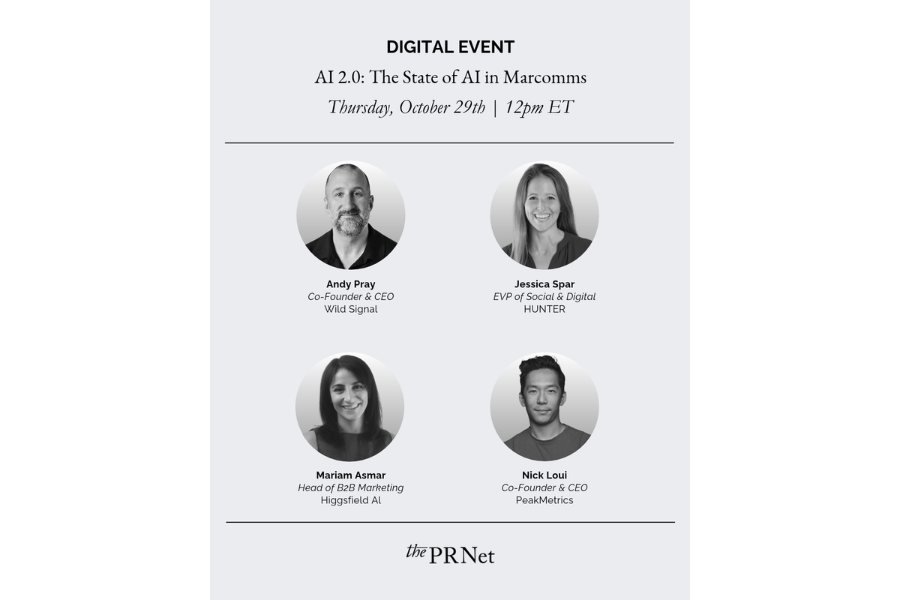
AI’s novelty phase is over. The conversation has moved past whether to use it and on to how: what’s working in practice, what isn’t, and what comes next. We hosted a conversation on the state of AI in marketing and communications, with leaders who are putting it to work every day. Moderated by Andy Pray, Co-Founder & CEO of Wild Signal, we heard from Nick Loui, Co-Founder & CEO of PeakMetrics; Jessica Spar, EVP of Social & Digital at HUNTER; and Mariam Asmar, Head of B2B Marketing at Higgsfield AI. They covered how their teams are applying AI day to day, the platforms and tasks they’re automating, the cautionary tales worth learning from, and where it’s all heading, including what it means for our industry when AI agents start acting on our behalf.
The takeaways:
AI has accelerated the pace of everything, including the tools built around it. Platforms now ship requested features in a matter of weeks, and the conversation moved from API integrations to MCP almost overnight, so staying current is the new version of keeping up with social algorithms.
The internet is becoming increasingly synthetic. By one estimate, around 70% of online content is now AI-generated, and roughly 20% of conversation around large brands comes from bots, rising past 30% on cultural issues, raising real questions about what a “culture moment” even is.
There’s a growing disclosure gap: the work is ready, but the industry isn’t ready to say how it was made. Brands and creative teams are producing AI work they’re proud of yet holding back from crediting it, wary of a zeitgeist that remains skeptical of AI.
Clients may not want the disclosure, but audiences still care. AI that helps people do their jobs better is largely accepted; AI that replaces human work, or a real moment that could simply have been filmed, is where sentiment sours.
The craft is evolving rather than disappearing. Licensing creators’ likenesses has opened new revenue streams, and in one AI ad competition, the winning team said the idea itself still took half their time.
Clips and coverage reporting are now largely a solved data problem, and cross-referencing hundreds of placements against AI citations takes seconds. The next frontier is moving from intelligence to action, while taste remains firmly human.
Adoption is a culture challenge, not a tools rollout. Teams need training, guardrails, and room to experiment without fear of failure; even skeptics should understand what AI can do today, since three months ago is already outdated.
The real gains come from connecting tools rather than using them in isolation. Linking platforms through MCP lets a single person build entire campaigns, storyboards, and ad variations, and agents can now help assemble whole virtual marketing teams.
AI is now an audience in its own right — agents read video rather than watch it — but over-optimizing is a trap. Citation tactics shift as models evolve, every channel still serves other goals in the funnel, formulaic optimization breeds sameness, and most website traffic is still human.
Visibility in AI starts with tracking the right prompts against competitors and studying which sources get cited. Roundups have made a comeback, the most-cited journalists can shape pitching strategy, and original data and distinct perspectives are what models reward.
Owned media matters more than ever. In one case, chatbots were spreading misinformation about a brand because of an outdated article on its own website, so an accurate site and a strong FAQ page are now front-line reputation tools.
Security deserves as much attention as opportunity. Deepfakes, hallucinations, and automated workflows that go rogue make human oversight and walled-garden AI environments essential for protecting client data.
The fundamentals haven’t changed — clarity, consistency, coherence, and a strong point of view. It’s PR with a new reader; the measurement and tracking are what’s new.